
The UN General Assembly has adopted a resolution, backed by India, to correct the world map for a more accurate representation of continental landmasses. The resolution addresses the distortions caused by the widely used Mercator projection, which minimises the perceived sizes of regions like Africa, Latin America, and South Asia, promoting an unbalanced global view. India supports the move towards more accurate cartographic practices, specifically endorsing broader use of Equal Area map projections.

India's ruling Bharatiya Janata Party (BJP) is actively courting Sri Lanka's Janatha Vimukthi Peramuna (JVP), a Marxist party with strong Sinhalese nationalist roots, marking a significant shift in bilateral relations despite ideological differences. This engagement, highlighted by a recent high-profile visit by JVP leader Tilvin Silva, aims to foster cooperation on economic projects and address New Delhi's concerns over slow progress in India-aided initiatives in the island nation.

India and China are in what experts call 'a cooperation-versus-competition situation'.

Prime Minister Narendra Modi, addressing the BRICS summit, called for a fundamental shift in global governance, advocating for the replacement of the current 'pyramid of privilege' with a 'platform of partnership' where the Global South becomes a 'rule shaper' rather than a 'rule follower'.

The International Cricket Council has announced significant format changes for the 2027 ODI World Cup and the 2028 T20 World Cup, aiming to increase competitiveness and consequence in both tournaments. The 2027 ODI World Cup will feature a Super Series and Super 7 stage, while the 2028 T20 World Cup will introduce a Super 10 stage after the group phase.

External Affairs Minister S Jaishankar has affirmed India's commitment to ensuring issues like a free, open, and rule-based maritime order, seafarer safety, and countering terror financing receive due attention at the UN Security Council during its 2028-29 term.

It is very unfortunate that China has decided to proceed with the controversial mega hydropower plants(despite the apparent opposition of many scientists in China). Why is Delhi silent about the development? asks Claude Arpi.

The Japanese PM's visit to Assam comes amid festering uneasiness in Tokyo about Beijing's assertiveness in the Indo-Pacific region.

It is plain to see that the US senate bill's real objective is to derail India's time-tested strategic partnership with Russia, points out Ambassador M K Bhadrakumar.

Seeking an expansion of the UN Security Council, he said India, Japan and Germany should be included in the Security Council as permanent members but without veto power.

India has expressed firm opposition to attacks on merchant shipping amidst the ongoing Iran conflict, revealing that several Indian nationals have died or are missing due to these incidents. The nation also called for restraint, de-escalation, and prioritising civilian safety in the region.

Through his commitment to democratic norms, debate, dissent and constitutionalism, Jawaharlal Nehru helped ensure that parliamentary democracy took deep root in independent India. Utkarsh Mishra evaluates Nehru's 17 years as India's first prime minister, examining his role in nation-building, democratic institution-building, economic planning, scientific advancement and foreign policy.

'Why not aspire for 8 or 9 or even 10 per cent?'

Legendary economist and former Federal Reserve chairman Alan Greenspan has died at the age of 100 due to complications related to Parkinson's disease, his wife Andrea Mitchell confirmed.

America's population and its media and its democratic structures seem fine with this, which is why Trump continues as he does, asserts Aakar Patel.

'Actual implementation of the 14-point agreement is proving hard to achieve let alone striking and sustaining a long-term treaty or deal.'

US President Donald Trump announced a finalised peace deal between the US and Iran, set for signing on June 19 in Switzerland, with key figures like J D Vance, Steve Witkoff, and Jared Kushner from the US side, and Abbas Araghchi and Mohammad Bagher Ghalibaf representing Iran, alongside Pakistani mediators Field Marshal Asim Munir, Shehbaz Sharif, Ishaq Dar, and Mohsin Naqvi, playing crucial roles in the diplomatic breakthrough.

Russia and China vetoed a Bahrain-backed UN resolution aimed at reopening the Strait of Hormuz. A resolution that was already diluted to secure their abstentions.

National Security Advisor Ajit Doval called for decisive action against terrorism and said there cannot be 'double standards' in the fight against it, while addressing an international security forum in Russia.
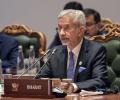
India has expressed serious concerns about the West Asia crisis and its potential impact on energy supplies and maritime stability, urging BRICS nations to find practical solutions to geopolitical challenges and unilateral sanctions.

For the foreseeable future, the most likely outcome remains continuation of the status quo. Taiwan will remain self-governing without formally declaring independence, while China continues to apply sustained pressure short of war, predict Krishnan Srinivasan and Manoj Mohanka.

The Bangladesh Cricket Board (BCB) has been dissolved and replaced with an ad-hoc committee following internal disputes and government intervention. Former captain Tamim Iqbal will lead the committee, tasked with holding elections within 90 days.

'The flip side of this is that he won't hesitate to call out India if he thinks its policies are hurting US economic interests or border US foreign policy goals.'

The Ministry of External Affairs (MEA) has stated that Prime Minister Narendra Modi and External Affairs Minister S Jaishankar are actively engaged with world leaders to promote dialogue and diplomacy for peace in West Asia, while also ensuring the safety and well-being of the Indian community in the region.

India has expressed strong concern over the targeting of commercial shipping in the Strait of Hormuz during the West Asia conflict, urging for the restoration of unimpeded navigation and global commerce.

The wedding ceremony of Sachin Tendulkar's son Arjun Tendulkar and Saaniya Chandok on Thursday turned into one of the biggest celebrity gatherings in Mumbai, drawing a galaxy of stars from across the cricketing world and Bollywood.

The world volleyball body FIVB has revoked the Volleyball Federation of India's recognition due to breaches of legal and administrative requirements, following complaints from players about poor facilities and selection politics.

The world volleyball body FIVB has revoked the Volleyball Federation of India's recognition with immediate effect for breach of legal and administrative requirements.

One of the most uncivilised characteristics of this war has been the total disregard for international law and the laws of armed conflict, asserts Vice Admiral Biswajit Dasgupta (retd).

Beijing has been wary of Sanae Takaichi's efforts to boost Japan's military profile since taking office six months ago, points out Dr Rajaram Panda.

The Congress party has criticised Prime Minister Narendra Modi's diplomatic efforts following the ceasefire agreement between the US and Iran, facilitated in part by Pakistan. The party claims this development undermines Modi's strategy and exposes his perceived failures in foreign policy.

Iran was the chance to arrange a concert of nations, to actually be a Vishwaguru. Instead, we are watching from the sidelines as Pakistan, the same country that is apparently still at war with Afghanistan, hosts talks between US-Israel and Iran. The irony is hard to miss, points out Amberish K Diwanji.

'The West Asia or the Gulf crisis has shown that what we develop as national infrastructure when things are not as bad as they could be, we forget to plan for adversities.'
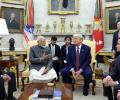
Prime Minister Narendra Modi and US President Donald Trump discussed the Middle East crisis, with a focus on the Strait of Hormuz.

The I-League, the country's second-tier football competition, will be restructured and rechristened as Indian Football League (IFL).

The Bangladesh government has approved its shooters to travel to India for next month's Asian Rifle and Pistol Championships, days after refusing to send its national cricket team to the country.

Iran has formally appealed to the United Nations Security Council and the UN Secretary-General, accusing the United States of inciting violence, interfering in Iran's internal affairs, and threatening military action, according to an official letter circulated by Iran's Permanent Mission to the UN.

Egypt, Pakistan, Saudi Arabia and Turkey met in Islamabad in what analysts say is the formal opening of a new diplomatic formation that could reshape the post-war regional order. Their immediate goal is a ceasefire; their larger ambition is to ensure that neither Iran nor Israel emerges from this war in a dominant position. Pakistan's foreign minister then flew directly to Beijing and mooted a Chinese role as guarantor of any eventual agreement. Prem Panicker continues his must read daily blog on the Gulf War.

Iran is fighting a different war: Older, slower, and in some ways more dangerous. Iran doesn't need to shoot down an F/A-18. It only needs to make the Strait of Hormuz feel dangerous long enough for insurance markets, shipping companies, and oil futures traders to do the rest. Prem Panicker continues his must-read daily blog on the war in the Middle East.

The question is no longer whether the war will expand. It has. The next few days will tell us whether the war stabilises around Hormuz or whether the Strait itself becomes the trigger for a far larger rupture. What to watch for over the next 48 hours is simple: Any move by the US toward direct naval control of the Strait; any credible Iranian attempt to disrupt or mine shipping lanes and, critically, whether energy infrastructure in the Gulf continues to be targeted.If those lines are crossed in tandem, the war will no longer be containable within the region.
